Is the Universe Real?
I taught a class the other day called “The Intelligent Universe,” a play on words from my book, The Magical Universe.
Part of my presentation involved exploring the 13.8-billion-year evolutionary history of the universe, highlighting specific crisis points where the universe exhibits intelligence and even a sense of magic.
One of the key turning points was the discovery of the atom. Remarkably, the negative electric charge of the electron perfectly balances the positive charge of the proton, enabling them to bond when conditions are just right.
Steven Hawking
I cited a quote by Stephen Hawking, who believed specific values were embedded in the universe at its beginning, enabling this and other “fine-tunings” to occur.
The extended quote I used in my class covered this, but then Hawking concluded with this interesting observation:
“Nevertheless, it seems clear that there are relatively few ranges of values for the numbers that would allow the development of any form of intelligent life. Most sets of values would give rise to universes that, although they might be very beautiful, would contain no one able to wonder at their beauty.” (Italics mine)
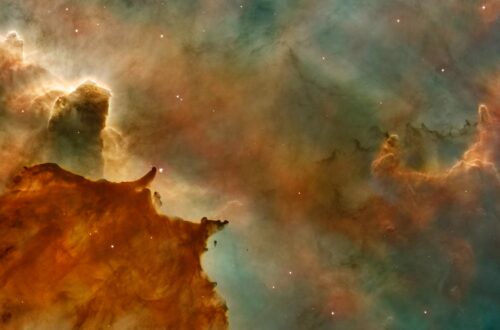
What caught my attention was his mention of these fine-tunings of the universe that could create universes of incredible beauty, with nobody around to appreciate them.
This gets to the heart of the title of this piece, “Is the Universe Real?” Hawking’s perspective is very materialistic. He believes that matter has its own reality, regardless of whether anyone is around to observe it. Most people probably agree with this idea. They think that when they leave home, it still exists even if they are not there to see it. Their proof: when they come back, they find it exactly as they left it.
But is that really the case? What exactly is perception? Is it like a camera capturing a snapshot of reality, so what we see truly reflects what is there? Most people would agree because we live in a materialistic, scientific culture, and that’s what we’ve been taught
Kant to the Rescue.
The idealist German philosopher Immanuel Kant begged to differ. He instituted what is called the “Copernican Revolution” in philosophy. In other words, Copernicus overturned the medieval view that the Sun revolved around the Earth by proving just the opposite, that the Earth revolves around the Sun.
Philosophically, before Kant, many believed our minds and ideas revolved around the physical world. They assumed there was a real world out there, and any ideas we discover about it had to be based on observations of the outer world.
This view led philosophy into a dead end. From this perspective, it became clear that no one could know anything with certainty. Both Empiricism and Rationalism collapsed because they had no answer to this problem.
Philosophy was in a quandary, and this dilemma awakened Kant from what he called his “dogmatic slumber.” Empiricist philosopher David Hume had taken empiricism as far as it could go and concluded we couldn’t know anything. It appeared philosophy was finished as an endeavor to understand the world.
Kant came to the rescue with his version of the Copernican Revolution. Kant argued that instead of the mind revolving around the physical world, it was the physical world that revolved around the mind. That may not sound like much, but it was a significant shift.
In other words, we see and understand the world not because the world is a certain way, but because our minds are structured in a certain way.
In short, our mind forms the image of the world, and this is the image we ultimately examine, so we create the world we then study.
How does this work? For example, suppose we’re examining a table. Do we see the table as it truly is? Kant says no. We don’t know what the table looks like in itself. We only know how we perceive it, but we can’t be sure if what we perceive reflects what actually exists.
How is that possible? Let’s examine how we perceive a table. Light waves bounce off the table, enter our eyes, and travel from our optic nerve to our brain, where it creates an image. The question is, does the image in our mind match what is actually out there? The answer is, we don’t know.
We never get to see what is out there because we can never get outside of our conditioned mind to view the table “objectively” without our filters. The result is that we have no idea what is out there.
The World is Not a Thing, but an Experience
Kant explained this by saying there are two worlds: the noumenal and the phenomenal. The noumenal world is the world as it truly is, beyond our perceptions. The phenomenal world is the world of our perceptions, shaped by the wiring of our brains and what Kant calls the categories of understanding, which divide and categorize the world, preventing us from seeing it as it truly is.
So, for Kant, what exists out there is filtered through the workings of our brain, shaping our perception of reality. Kant even argues that space and time do not exist out there in the world but rather things we impose on it. In short, we have no true idea what the world really is.
Returning to Hawking’s statement about a beautiful universe with no one around to appreciate it, we can now see how this conflicts with Kant’s philosophy and how his new perspective has fundamentally transformed the field of philosophy. That is why Kant is considered one of the most influential philosophers.
It’s not like this material unknown universe, devoid of life, is just waiting around for someone to appreciate its beauty. According to Kant, we don’t know what that beautiful universe is.
To be clear, Kant is not claiming that everything outside is just in the mind; instead, he’s saying there is something out there, but no one knows what it is. Its true nature lies beyond our perceptual ability.
The universe is not an “I know not what,” but an experience for every creature to perceive. Each experience, especially among different species, varies. They don’t see the same world because their minds and perceptual hardware are different, which brings different aspects of the universe to the forefront. What might look like a beautiful universe to some humans is something quite different to other species.
So, to conclude, is the universe real? Yes, it’s real, but it’s not a thing, it’s an experience. The question is: an experience of what?